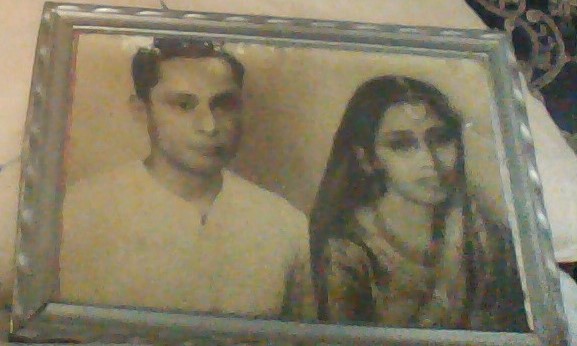
Tuesday, 8 September 2015

George Shalom - 9th September

George happy with opening of the sauna, steam and jacuzzi at Grand View Resort, Jamta, HP.
                                      George Shalom 9th September 1946 - 25th January 2010

"We shall rough it out together" - said George when he proposed to me in early 1985.  Of course, it had to be that and nothing else - he was a divorcee (divested of his sons and property) and I was a divorcee with three small children. Ideal, isn't it?  So we roughed it out for nearly 25 years. I say nearly because he bade a final goodbye just two months short of our silver jubilee.


3 years of living as a divorcee had taught me that I was a social outcast, a free-for-all target, other wives looking me up suspiciously (as if I was about to lure away her husband any moment), an after-thought in social invitations where my family was concerned. In other words, an undeclared pariah in my family circle or outside. I lived for three years with another divorced friend of mine and we both went through some humiliating situations. I do not feel society has changed much in all these years. Single women are still looked at in a suspicious manner, unless she has a powerful father, brother or boyfriend by her side. No one wants to know why and how she is dovorced, whether she is at fault at all.  

George was a big change in our lives - he was from Delhi, of a different faith, spoke English or Hindi, enjoyed beef curry, drank rum (okay), worked in hotels.  However, he loved cooking. My older children had great birthday parties hosted by him at home. He would cook, serve, organise games for the kids and even helped in return gifts!  So yes this change was good, it was like a breath of fresh air with new ideas, philosophies. attitudes, lifestyle, and a new city to live in - Secunderabad.

The twin cities of Secunderabad and Hyderabad were being really spruced up at that time by the then Chief Minister - N.T.Rama Rao.  The Tank-bund used to be a great place to go to in the evenings, stroll around, have a munch or two, watch the boats on the lake.  George was also in  charge of the Boat Club there.  I remember they used to make awesome chicken sandwiches at the Secunderabad club. It was here I had my fourth child, delivered with the help of a beautiful, muslim lady doctor - Dr, Nighat Baig, who also happened to be a member of the Club. We named this new daughter Sharon Grace Shalom or Kuki.

George loved dogs and we learned to love them, too. The Club had many dogs on its grounds and one of the huge female dogs gave birth to a litter. George brought home two tiny pups, I named them Bhodu and Guriyasan. I remember one night Guriyasan went out and was missing; George and all of us went looking for him with big torches. Found him but he did not live for long. Bhodu was with us till we left Secunderabad in 1989.  Meanwhile, one day while coming back from the market we had another dog follow us home and she refused to leave. Named her Lassie. She was too well-behaved to be a street dog. Anyway my life consisted of cooking separately for Bhodu and Lassie in addition to my regular chores. There were times when I would be exhausted and stop cooking for them and leave the door open for them to leave. No way. There they would sitting tight. No food, no matter, but we are not going - seemed what they said. So I go back and make extra meat for the faithful four-legged children I had.

I went back to Hyderabad 25 years later in 2010. Located the house we lived in for a short while in Tarnaka. Things have changed drastically. That house is a big apartment building and the landlady's daughter - June Franklin, lives in one of them. It was gratifying to to know she recognised me immediately! Asked after George, told her that he had passed on his journey, she also enquired about my three children. She did not know about Kuki, as she was born while we lived at the Club.
Icecream, Vimto and Pussycat
Here is a picture taken by June's elder sister when she came visiting from Australia. Icecream (Shib Shekhar Bose), Vimto (Pavitra Shekhar Bose), Pussycat(Chandra Prova Bose, later christened to Clara Pearl Shalom). 1985.
 
Why did George come into my life? Why did I prefer him to other similar proposals from rich men? The only thing that mattered to me was that I must not lose my children and George seemed to be a safe bet. He wanted a family and I looked forward to a proper conservative home with a mom and a dad and dinners together. I had so much in my childhood, I felt I owed this much to my kids, if not all the pomp and high standards I had grown up with. George was down-to-earth, a Virgo, a man who knew how to be a responsible man, loving (yes), and caring.  What more could a woman in my situation ask for? And yes we fell in love gradually, more towards the end.

You know, funny thing is when he and I went to live in Jamta for good, the first thing we discussed was how do we wish to be dealt with after our death. We decided we have to locate a Christian cemetry and a Hindu burning ghat nearby in this remote village of Himachal Pradesh. That man made me go through the works when he just upped and breathed his last. I must say the Carmel Father and sisters did a splendid job in helping me - I was lost about Christian or Catholic rituals. Not to forget the Jamta villagers who came forward to give me land to bury my husband whio had been a part of them for more than ten years. That is the first time I saw a Gram Panchayat meeting. More in my other blog.

George was always married to hotels. Any woman would always hold second place in his life and heart. Period. But I understood this pretty late into our marriage; an earlier wisdom would have helped to avoid many confrontations and my stupid over-reactions. After nearly 25 years of being married to George, a hotel man, I can say any spouse of a hotel employee should never expect the partner to have predictable timings or schedule. Yet life can be full of fun and surprises. do not come with preconceived notions and expectations. Hahaha!

Happy birthday, George! Sometimes I miss having you around.  I know you are playing frisbee up there somewhere with Lucky. Not to worry, I'll join you guys soon. God bless your souls. Amen! 

Friday, 7 August 2015

Wedding_rings.jpg Marriage made in heaven       WIN_20150807_101652 (2).JPG

7th August, 1950 is the day when wedding bells rang for Gyanendra Chandra Deb and Nani Bala Hore.  That day Nani Bala Hore became Bela Deb for good. The day when two confirmed bachelors got united for life and stayed united till ‘death do us part’ story. A very simple and normal unison, except both Ma and Baba were well beyond the marriageable age and yet, as if, made for each other couple.

Baba had a sizeable temper and Ma was always the quiet one. I do not remember even one incident when I heard my parents fighting or shouting at each other.  Funny!  At least not during my childhood or even while growing up or when we were down in the dumps (financially). Their skirmishes started when Ma was paralysed due to cerebral attack, years after I was already a mother of four.  

Ma loved to call on her attendant to spit in the spittoon (her age-old habit) and Baba would not let the nurse give her the spittoon,  because he said she did not need to do it!  Ma would then bang on the bedside with her comb or whatever to call her attendant; Baba would remove everything handy from around her.  My children and I were living with my parents in those days and as soon as Baba removed things one of the kids would stealthily bring in a spoon or ladle from the kitchen and give it to their grandma, so she could summon her attendant.  Baba would hear the sound and come as fast as his old legs could carry him to see how she got hold of anything at all to make a noise.  He would immediately take away whatever Ma had in her hand, my kids would again bring something else and give her to bang on the wall or her bed.  This circus could continue if I (when present) did not stop the children. Baba never solved the mystery but blamed the attendant and she did not mind, because as she told me she enjoyed the show.

Ma spent her adult life teaching in various colleges throughout North India as professor or principal, but in retrospect I wonder how she transformed into a docile housewife looking after a staunch Brahmin widow of a mother-in-law and still staying in her good books. It had to be so, because my grandmother refused to go and live with her other married sons In Delhi or Dehradun or Agra!

Ma and Baba never quarrelled or argued in front of us children, yet when did they resolve their issues, if any?  Maybe when they went out for their evening walk, I can only presume. This is one thing I failed in imbibing from my parents, but as an excuse I always felt both the parties should have the same sensibilities, which was not in my case.

Both my parents encouraged my brother and me to bring our friends home, often for small children parties and play indoor games. Baba always said if you cannot bring your friend home then that friend cannot be worthy of being called a friend.  It did not matter what financial status the friend came from - what mattered was the upbringing. Throughout my growing up years I was banned only once from playing with a girl after I repeated a word she had uttered during play.

I was brought up in the same way as my brother, so I played hockey, cricket, tried to fly kites, played marbles and gulli-danda. At home we had the meccano set, scrabbles or word-making set, remote controlled helicopter or cars, carrom board and a whole set of records. The collection we had was huge and varied; whether Rabindra sangeet or Pat Boone, Cliff Richard, Elvis Presley (my favourite), Jim Reeves, I could reminiscence on and on.  Not to forget some classical music - both Indian and Western, not exactly our favourites. The addition of Kishore Kumar, Mohd Rafi, Lata Mangeshkar records happened when my brother started seeing Hindi movies.

I still remember that evening in 1966 when my parents had to attend a cocktail held in honour of Queen Elizabeth at the British High Commission premises. Ma never liked dressing up or wearing jewelry of any kind, yet that evening I draped the saree around Ma and took out her diamond earrings and insisted she put it on.  She gave in, even decked her neck with a matching necklace; maybe keeping the occasion in mind. Baba of course looked dapper as always in his cocktail suit.  Yes we were very proud of our handsome parents.  God bless their noble souls.


Friday, 24 July 2015

Ashok Bose

24th July 1942 - 29th September 1998


Buddha Bose's eldest child and Bishnu Charan Ghosh's eldest grandson at 4/2 Rammohan Roy Road, Calcutta-9, grew in the lap of luxury and attention. He was born shortly after Bishnu Ghosh’s eldest son died in a fire accident and therefore, the amount of doting and pampering Ashok received from his grandparents and parents cannot be imagined. Nanima (Ashalata Ghosh) told me once that if and when Ashok sat on the floor, someone would immediately make him sit on a silk asana or mat.

Besides being born at an opportune time, Ashok was incredibly handsome right from his cradle. Clear blue eyes (which turned clear grey with green flecks in middle age) and the fair skin made him a winner any time. In fact, when I first met him in 1970 I compared him to Ryan O’Neill (remember Love Story); Ashok could easily pass off as a carbon copy, inclusive of the birthmark near the nose.  Just the other day one of his school and classmates, Biswanath Mukherjee said Ashok was too handsome!

Ashok was an adorable child, no doubt, but his intelligence taught him how to charm everyone and get what he wanted, even from a very young age. Not that what he wanted was always beneficial or required.  He would get extra pocket money from his grandfather by telling him what he wanted to hear and then play the same game with others in the house. He did not receive the ethical guidance on such matters, to be honest, and so what started as a way to whet his childhood appetite became a way of life.

Ashok suffered from severe convulsions when just a few months old. His mother, who was just sixteen years older, had her parents to give her support and courage during those devastating situations. I know how terrible it can be for any parent because my eldest son inherited this illness with the good looks from his father. Back to the story, Ashok was sedated with Gardenal (my son too) for some time and then eventually the doctors predicted that he would either become epileptic or develop uncontrollable temper. The latter became a reality.

Biswanath, Ashok’s friend told me that he would often go for shows on yoga and other physical shows with his grandfather even during the school days. I know he was a great yogasanist and could tell a person’s ailments just by looking at him or her. I am witness to that. But he was frivolous in his attitude and by the time we got married he was already on the way to leisure, pleasure and only ‘my way’. He never took anything seriously and was never aware of his responsibilities as a husband or a father.

Ashok loved children.  He would play ball or catch-catch with his own sons as well as with his brother’s at times.  However, the kids sensed his unruly temper and played along to keep him happy.  Ashok could fly off the handle at any given time.  Then there were moments when he would come pretty high, loaded with small toys or games for the children.  Those times he could be very endearing. He was also quite a disciplinarian and would never hesitate to try to correct even outsiders, if he saw things out of order.

By the time he finished college (Scottish Church) Ashok had developed a strong taste for alcohol.  Unfortunately, there was very little discipline at home.  He grew up in an atmosphere where he had the idea that he was God’s gift to women and his family. No constraints at home just paved the way for a disastrous life.  But, in those years there are two things worth mentioning. He was an excellent pilot and had a commercial pilot license (CPL). He was even inducted into Indian Airlines, he and a few of his batchmates from Behala Flying Club, where the instructors held him up as an ideal example for the new students.  The airlines job did not last for long, not even months!  Rajiv Gandhi (Ashok’s friend and junior) and a few others were appointed before Ashok’s batch was taken in and that upset dear Ashok. He created a ruckus and naturally Ashok’s flying career came to an end. Free at last!

Ashok more or less got what he wanted.  So when he became an adult he wanted a plane he got one.  He wanted to go to Japan, soon after our first child was born, he got it.  He came back a few months later and then wanted to go Thailand. Yes, why not. So it was arranged. This is one place where Ashok did good work. Yes he taught yoga, opened a centre and even took an expert masseuse from his grandfather’s (Ghosh’s College of Physical Education) centre to Bangkok. He helped this man, Modo, settle down there, paid for his fare back to India to get married and then helped him to go back to Thailand with his new wife.  How sweet!  As far as I know Modo is still there and now his son is running a modern yoga centre in Bangkok.

Biswanath Mukherjee told me that years ago when their Higher Secondary results were out, Ashok did somersaults of joy on the lawns of Hindu School.  Sure knew yoga and the tricks!  

Ashok was highly intelligent, could be compassionate to the degree of covering a beggar on the road with his own expensive shawl in a cold winter night, without a second thought. He could sing beautifully. He would often sing Rabindra sangeet in our house to please my dad (Brahmo).  Yes we loved those moments. His favourite song I remember was - “Prithibi amare chay, rekhona bendhe amay. chhere dao priya, khule dao bahu dor.”  He sang this quite often in a loud, abundantly musical voice.

Ashok had his last and final convulsive attack on 29th September, 1998.  It was Durga Puja Ashtami day.  When finally my kids and I could get his body released from the morgue and perform his last rites it was Lakshmi Pujo day, 5th October, 1998.   The above photo was taken in 1997, just a year before he passed away.

Wednesday, 22 July 2015

"Deb here" - My father

Gyanendra Chandra Deb
(2nd May 1903 - 22nd July 1993)


My father was formally known as Gyanendra Chandra Deb. However, he had a few nicknames, like his younger cousins called him "Pushun-da" and the older ones "Pushun", to his nieces and nephews he was "Sundar-Kaku" or "Sundar-Jethu" as applicable.  My grandmother (Thakurma) would shriek out "Pushoon"as soon as he came back from office - to complain about her imaginary ailments and ill-treatment!  Thakurma was pretty old and had a right to be delusional and secretly I feel she had dementia too. She would complain how she was not given any lunch or the cook had not bathed before cooking her food etc. etc. I do not remember Baba making any issue about such complaints from his beautiful mother, even though I have seen many times how he would lovingly assure his mother that he would set everybody straight right then. Baba doted on his mother and she lived with him always, not with her other four sons.

I believe it was the main reason he did not get married till he was knocking at 50. He would have probably stayed a bachelor if it was not for his third brother and my chhoto mama secretly arranging for him to meet my mother - Nanibala Hore. She was another doting daughter who was well past her marriageable age and happily being a principal of ladys college in Punjab and contributing towards her family. Her father, my dadu had retired as an Inspector of schools of north Bengal and my mother did not harbour any secret fantasies about marriage; even though two of her sisters had been married off.   Well, providence played its part and two confirmed bachelors got married on 7th August, 1950.

It was quite normal for my dada and I to understand that our Thakurma was the queen-bee of the establishment, although she hardly ever moved from her bed. Everything and everyone was at her beck and call. Ma, of course had resigned from her job (before her marriage she had relocated to Calcutta and was Senior Customs Officer at DumDum airport) and had become a full-time house-wife or home-maker. I mention this scenario because I found later on that it was not a normal situation in many homes - the old parent/s were quite often relegated to a corner of the house and given less heed, even in those days.  Thakurma passed away in the early 60s after suffering from serious bedsores.

Baba was very serious about certain things - study time, play time, music time, dinner time, his & Ma's one-hour evening walk and the most important - 9 o'clock news time.  He also made sure we kneeled down and prayed before bed time, often he would pray along with us.  And, yes the first thing in the morning say another prayer.  Wonder of wonders we did not have any altar in the house - no pictures of God or Goddess.  There was a nice painting of Buddha, another one of Simon kneeling down and praying to a glow of light above.  There was another of Mother Mary & infant Jesus, which I took for my school function and never brought it back. Of course, a standing picture of Rabindra Nath Tagore. If there was any touch of religion or spirituality, it was a photo of Bejoy Krishna Goswami, who was my Thakurma's Guru. But all these paintings and photograph hung around the house on different walls - more like decor.

Baba would always polish his shoes every morning before his bath, no servant was allowed to do that. Dada and I were also introduced to this ritual, that is we polished our school shoes while our ayahs watched.  The affair used to be more sombre.  Just outside the British High Commission's Zephyr car would be standing with the chauffered driver, Gaffoor standing at atention, to take Baba to work.  Hilarious? Comical? Maybe or maybe not. These were principles driven into us children - to do as much of our own work as possible.  To be completely independent.  Like Baba we too had to wash our own underwears and socks, not to be given to the washerwoman with the rest of the clothes. Soon our younger sister who came nearly seven years after me had to follow the same strict discipline. However, there was some laxity when my parents dealt with her - after all she was the baby of the family!

Baba loved good food, so do I.  He enjoyed cooking biryani on sundays. As soon as the Ic-mic cooker came into the market, he bought one and we all looked forward to sunday special lunch.  Baba would do all the cutting, washing etc himself and then spread the biryani for all to relish. He cooked this well!

Did I mention that Baba never used a toothbrush to brush his teeth? He used neem sticks or neem-datun. Baba even took a great number of neem-datun with him when he had to go and live in Europe on official work for sometime.  We were made to brush with neem toothpaste. As we grew and became aware of goods. we influenced Ma to buy Binaca toothpaste. Those days these pastes used to come with different plastic/rubber animal figures.  Quite a collection we had.

Every year in the month of Magh (January-February) we religiously went to the Brahmo samaj at Cornwallis Street and Bhawanipore. The egaroi magh was always a special day, you just had to be there, meet friends, relatives and enjoy the simple khichri, chachari, chutney, cabbage curry etc.  At the samaj we had to sit quietly while the priest read out from the Upanishad followed by Brahmo sangeet.  The priest would read a stanza and then a song, and then another stanza and then another song. It would continue for some hours till about lunch time. In retrospect, I do not remember any child or infant making any noise inside the hall while the prayers were on.  And there were no cell pnones those days, but even if there were I am sure no one would dream of shattering the pin-drop silence inside the prayer hall.  Awesome discipline!  I remember the samaj as a very sacred place but no idols were worshipped. The dias where the priest and singers sat would be decorated with lots of flowers, especially rajanigandha, Baba's favourite.

I read my paternal grandfather, Ishan Chandra Dev had the title of Rai Saheb bestowed on him by the British for his exemplary contribution towards the geograpgical society work.  Baba never mentioned about it; I read the citing behind my Thakur-da's photo in the special suit.  Baba was born and brought up in Dehradun.  He and his four brothers kept night watch beating tins to scare away bats in their 100-bigha fruit orchard.  They studied in the DAV school, where English was taught in Hindi.  For example, Baba told us how they were taught to spell 'scale' - hyess, cc, yay, yel, eee. Pronounced as - 'sacale'.  And yet Baba spoke English - queen's English, so much so when our friends used to call us they would get scared if Baba picked up the phone. My brother's friends from St.Xavier's would ask him who is the Englishman who answers the phone with - "Deb here" ?  Baba had also learned German, Spanish and French by playing the linguaphone records during his bachelor days.

Baba or Ma never revealed to us that he came from a Brahmin lineage, that my Thakurma was the first (Mukherjee) Brahmin girl to wear leather chappals to school in her young days. Both my grandparents belonged to Sylhet (in Bangladesh) and both their families were Brahmin zamindars and both their fathers had turned to Brahmo samaj when they got repulsed by the Brahmin culture of oppression practiced at home.

Discipline, honesty, respect, independence, physically active and believing in dignity of labour are my inheritance from my dad. These stood me in good stead in my tumultous life.  Thank you God for giving me such beautiful parents.

Monday, 15 June 2015

Helen Manju Lee - All for God's glorification


                                          Manju Lee, Sarala in the middle (back) and myself.

1952 - Christmas morning and twelve year old Helen Manju Lee has come home for Christmas from her boarding.  Not that her home was far from school - all in the same campus of Lee Memorial School, Calcutta.   At home was dad and step mom; and Manju got busy grinding the spices for the Christmmas dinner meat.  But then little Manju was eager to finish her chore quickly as she had to rush to her elder sister who would do her hair before she ran to church.  Oh yes, did I tell you her elder sister Monty lived in the boarding just behind the residential  quarters and was not allowed to come home- some school rule.  The job was not done perfectly and step mom came into the kitchen as Manju was about to leave.  She exclaimed at the roughly done up paste and refused to cook.  Off she went to her bed.  Manju, all dressed up except for her hair, sat crying at the window till dad came home.

Dad comforted her and allowed her to go out.  When Manju and her sister and brothers came back from church they found their dad merrily cooking the dinner.  Life was normal again.  Not until Manju came down with her acute pain in the knees, something that had been occuring quite often and treated with home remedies.  She had to be rushed to the hospital as the pain was excruciating this time.  The school authorities made arrangements for her at the Lady Dufferin Hospital and the doctor was soon summoned to give her a thorough check-up.  Awaiting check reports till the next day, Manju was strictly confined to bed.  Manju remembers the last time she walked was from home to the hospital on that fateful day.

At first Manju was given a room, but the child in her could not keep quiet and soon she made friends with other patients.  One day the doctor walked in to find her sitting up and enjoying a small private party with some patients.  Thereafter, she was given a bed in the ward, where she was constantly under the supervision of the nurse on duty.  That meant no getting up!  However, here too she kept herself busy reading the Bible and chatting with next-bed neighbours.  The young girl in the next bed was a Catholic and often had her Catholic priests come over for a visit.  On one of these occassions Manju asked for the communion (wafer dipped in wine) that used to be given to the girl,  The priests did give her, even though they came to know she was Protestant.  Once the priests told her that if she converted to a protestant they would pray to Jesus to cure her.  This idea did not appeal to Manju's young integrity and she declined politely,  She said that if Jesus or Mary could cure her on their prayers then Jesus could do it on hers too.   So no thank you.

Manju's medical tests continued and finally the doctors concluded she had bone tuberculosis.  Her legs were put in cast and she was bombarded with medicines and injections for a year. When the casts were taken off, her legs were found to have twisted and were in a worse shape than before.  Tests were again done and anti-TB medication began but unfortuantely the damage had already been done. 3 years later Manju came out of the hospital in a wheel chair with a body that had lost control of her muscles.  Both her legs were twisted and useless, and her arms hung up like loose appendages.  Now Manju knew her every action would be dependant on others - a horribly undignified way of living.
Manju clung on to her Bible where she read in 1 Corinthians 10:31 - "So whether you eat or drink or whatever you do,do it all for the glory of God."  Jesus's sufferings also influenced her; how He went through all but never stopped praising the Lord.  From that young age Manju was determined to overcome her physical incapacity in the glory of God.  So the worse her condition became more fierce was her faith.  She insisted on continuing with her studies and here she paused to mention that after Christmas that fateful year she was to be admitted to United Missionary School for Girls boarding to finish her schooling.  Manju was given space at the end of the girls' dotmitory in Lee Memorial, where she could study and also tutor some unfortunate girls.  However, the arrangement was not comfortable so she was shifted to the room before the dormotory; here her father and siblings could come and visit her easily.  Soon Manju was transferred to a spacious room, where she could teach, paint with her tingling left hand.  The hand had become partially flexible after a Dr.Gurst (an American orthopaedic surgeon) operated on it.  She is very thankful to the doctor even today.  More than forty years ago I used to visit Manjudi (di as in elder sister) in this very room and admire the fact that a person with absolute disablity could smile, paint, teach and laugh like us normal beings!  I even bought one of her handpainted fabric painted saris that I wore for years.  Remarkable!

Manjudi says about twenty years ago the erstwhile principal who had gone for 25 years returned and did not like the arrangement.  Therefore, Manju had to move out of Lee Memorial - a home she had known for so many years.  After the heart-wrenching departure, she lived with her married brother for sometime and then her sister's (Montydi) children got her a flat in Santoshpur and till date take care of all her financial needs.  Manjudi has one of her old students, Sarala, living with her and takes care of her meticuloiusly.  Sarala says she hardly finds Manjudi upset or angry; in fact, she admits she vents more anger than Manjudi.  Manjudi is still the same - smiling, generous, loving, praying and alert, even at the age of 76 years.    The best part is she prays for one and all every day, remembers all our children and their problems and prays for them!   Be there a bombing or an accident or a calamity, if Manjudi gets to know she must send a prayer for all those affected.
Yes, she admits there were times when she could not understand her condition, would fret, feel angry but it was her Bible that kept her sane and focussed on life's positive side.  She is happy and grateful that God sent her angels to keep her going with dignity and pride, irrespective of the fact that she was never capable of earning her own living or looking after herself .  She says her life is for the glorification of God and she is thankful to have been a messenger for all.  It is nearly 63 years that Helen Manju Lee is totally confined to her bed and wheel chair; her every personal detail is taken care of by Sarala.  And yet the lady looks clean, young, shining and is ever ready to greet all and sundry with a blessing; and she has no bed sores.  Amazing!  All in the glorification of God.  Manjudi did not have to grind spices again.  Amen!

Thursday, 15 January 2015

Ahmadabad – Wine/Auto fare/Veg-Nonveg

For the past few months the newspapers have been full of great hype about Gujarat state, more particularly its capital city, Ahmadabad.  Not surprisingly, I was quite excited about my trip to this city and expected to have a marvelous experience.

Experience 1 – The domestic airport was quite a letdown, even though I was touched by the lack of security.  I assumed that the people and the authorities here were confident about safety or rather had no security issues as in other airports.  A minor thought that could be flicked off and I looked forward to what the city had in store as I proceeded towards my place of stay.  Well, it was late and I guess people winded up early in Ahmadabad, so not much of a hustle-bustle on the roads.

Experience 2 – when shopping for the Dish TV connection I was quite taken aback by the shop-keeper’s insistence on Tata Sky or some other cable connection.  When he saw I was determined on my choice of television entertainment source, he remarked –“people here rarely opt for this connection. They would rather go for anything but this.  Period.”  I kept wondering (as I am prone to) why such a distaste for this particular brand, as I have found Dish TV to be customer-friendly and most importantly has FM channels, like no other.  One thought crept up – Shah Rukh Khan is the face of Dish TV.  Could that be a deterrent? Your guess is as good as mine.

Experience 3 - Ahmadabad is quite full of bootleggers (people who sell alcohol at a premium price on the quiet) and as per certain survey alcohol consumption in Gujarat is comparably higher than other places in India.  Yet, this is a dry state, which means no wine shops; no excise revenue for the state coffers.  The alcohol business which is conducted undercover sure brings in large profits, since the items are sold at four times the normal price.  Who does it benefit?  How does this thrive?
Taken from another angle which is the popular slogan “Gandhiji’s home state” and so no intoxicating substances should be available.  I would like to know how come cigarettes, zarda, ghutka, pan masala and pan are easily available at every second store. Are these not counted among the intoxicating vices or did the great man (pardon; no offense meant) endorse their use?

Experience 4 – autos in Ahmadabad run on the meter or off the meter.  The meter is Rs.20/- down and then increases after the first kilometer.  So it is definitely not 10/- per kilometer, as I have heard a number of times on the news channels.

Experience 5 – people are very particular about flouting their vegetarian status and do not think twice about screwing up their noses at the mere mention of fish/meat, onion/garlic.  Even children of such families look down on you if they discover you eat ‘flesh’!    Should I mention I am a Brahmin by birth and wait for their expected reactions?  Maybe not.

Experience 6 – I have traveled far and wide in India and lived in various places due to jobs.  I found match boxes, made in Tamil Nadu, with bold Gujarati written on them being sold here. I have found branded detergent powder packets with bold Gujarati writing and small English below.  I did not see such exclusive state-wise promotions anywhere else in India.  The pipe gas people fixes up the connection and then make you sign a paper which is entirely in Gujarati; no alternate language form available.  As the boys answered to my query about an English form – ‘why should you worry? You are here today and will be gone tomorrow, so don’t worry about the written material.’  I was aghast with their complete assumption that we, the outsiders would not be here for long. And yet, most of the youngsters from this state are filing for visas to the USA, Canada, UK and Australia.  Yes, the visa counseling business is flourishing here waving a green flag; and if you wish to work for them you must sign a bond for 4 years.


Oh yes!  Did I tell you about the weekend rush out?  Every Friday evening flights go chock-a-bloc with young Ahmadabadis to Bombay, Daman Di u and bring back the refreshed youngsters by Mondays.